

The way we produce and consume food is changing. Consumers, supermarkets, and producers now share a growing concern: consuming safer and healthier food under the principles of food safety and good agricultural practices, without compromising productivity or farm profitability.
In this context, Veganic Food Care was created—Veganic’s new strategic project developed together with farmers, supermarkets, and distribution chains. This program becomes a key pillar of our purpose: to leave a better world for future generations through more sustainable and responsible agriculture.
A real commitment to food, health and well-being
Veganic Food Care encompasses a set of actions that promote healthier nutrition based on fruits and vegetables produced under an IPM system, reinforcing food safety, quality, and the connection between nutrition, well-being, and sustainability.
News warning about the presence of pesticide residues in fresh foods is becoming increasingly common, raising social concern and increasing consumer demands regarding:
- Food safety
- Transparency in production
- Food traceability
- Environmental impact
Today’s consumer wants to know what they eat, how it is produced, and what impact it has on their health and the planet. At Veganic we believe that change begins in the field but must reach the supermarket shelf. That is why Veganic Food Care connects production, distribution, and consumption within a sustainable and measurable agricultural model.
What is Veganic Food Care?
Veganic Food Care is a collaborative project between Veganic, supermarkets, and agricultural producers designed to implement advanced Integrated Pest Management (IPM) programs and soil health strategies, with the goal of advancing toward more sustainable agriculture.
Our approach is based on several key pillars.
Advanced Integrated Pest Management (IPM) protocols
We apply comprehensive foliar protection protocols combining:
- Biocontrol products
- Beneficial insects
- Reduced and selective use of products for pest and disease control
- Continuous monitoring
This enables effective and sustainable control of the main pests and diseases affecting each crop.

Soil health and microbiota strategies
Together with the Veganic Planet Care project, we work on soil regeneration, microbiota enhancement, soil health, and strengthening of the root system through beneficial microorganisms that:
- Increase soil microbiota
- Improve nutrient assimilation (N-P-K and micronutrients)
- Regenerate the biological structure of the soil
Reduction of synthetic chemical use
Veganic Food Care programs allow for a progressive reduction—or even elimination—of synthetic chemical products, thanks to increased use of biocontrol solutions combining different tools such as plant boosters, biofertilizers, biofungicides, and others.
Reduction of residues in fruits and vegetables
The implementation of these protocols enables a significant reduction of residues at harvest, verified through continuous multi-residue analyses. This is a key indicator for producing fruits and vegetables fully aligned with the requirements of European supermarkets and consumers.
Reduced environmental impact
The environmental impact of these programs is evaluated using the EIQ index developed by Cornell University, allowing objective measurement of sustainability improvements.
Veganic Food Care IPM programs reduce the environmental impact associated with chemical use and clearly improve one of the key sustainability indicators in agriculture.
Greater profitability for farmers
Our programs combine foliar biocontrol tools and soil solutions, allowing farmers to:
- Improve productivity
- Increase the final quality of fruits and vegetables
Maintain or improve farm profitability
Measurable and field-validated results
The objective of the model is clear:
- Agronomic efficacy
- Reduction in the use of synthetic chemicals
- Greater food safety
- Lower environmental impact
All without compromising productivity, profitability, or regulatory compliance.
A clear value proposition for supermarkets and distribution
Veganic Food Care allows supermarkets and distribution chains to:
- Receive fruits and vegetables adapted to their requirements in terms of MRLs (Maximum Residue Limits) and a drastic reduction in the number of synthetic active ingredients
- Align their supply chain with sustainability and quality standards
- Reduce the risk of commercial or reputational rejections
- Ensure traceability and consistency across suppliers
All of this without needing to manage technical field operations directly.
Veganic acts as a specialized technical partner, connecting supermarkets with customized IPM programs implemented directly on farms.
A win-win model for producers and distribution
The Veganic Food Care model follows a clear and efficient roadmap:
- Veganic designs complete IPM protocols (Veganic Food Care) and soil health strategies (Veganic Planet Care)
- Supermarket suppliers implement these protocols together with the Veganic technical team
- Farmers request the necessary products from Veganic distribution in their area
- Distributors supply the solutions and actively participate in joint work with producers
- The result: crops with lower synthetic chemical use, effective pest control, and production aligned with market requirements
Veganic technically supports farmers throughout the entire process to ensure real, measurable, and sustainable results.
Scientific evidence and measurable results: Open Days in Almería
At Veganic we believe in demonstrating with facts that more sustainable agriculture is possible.
During the first week of February we organized Open Days in Almería, in a showroom format, where we demonstrated under real cultivation conditions that it is possible to reduce chemical applications and environmental impact while maintaining productivity and profitability.
Success case: snack cucumber crop in Almería
Trial data
Location: Almería, Spain
Cooperative: Cohorsan
Crop
- Snack cucumber – variety Quarto
- 20,000 plants/ha (spacing 0.5 × 2 m)
- Drip irrigation
Trial period
- Start: November 2025
End: March 2026
Experimental design
- Comparison between the farmer’s standard protocol vs Veganic protocol
- 12,000 m² greenhouse
- 2 plots of 6,000 m²
- 4 replications per treatment
Evaluated indicators (KPIs)
- Control efficacy (incidence and severity)
- Reduction of chemical active ingredients
- Reduction of chemical residues at harvest
- Total production (harvest)
- Soil microbiome and nutrient availability
- Cornell EIQ environmental impact index
- Economic return (ROI)
Results obtained
The results confirmed the potential of the Veganic Food Care model:
- Same control efficacy against Downy Mildew, Silvering, and Botrytis
- 55% reduction in the use of synthetic chemicals
- Reduction of chemical active ingredients from 5 to 2 (-60%)
- Residue reduction at harvest: from 111% to 11% of MRL
- +2,614 kg additional production compared to the control (13% yield increase)
- 60% reduction in environmental impact
- Clear improvement in farmer profitability, with a positive ROI of nearly €1 per m²
These results demonstrate that sustainability and profitability can go hand in hand in modern agriculture.
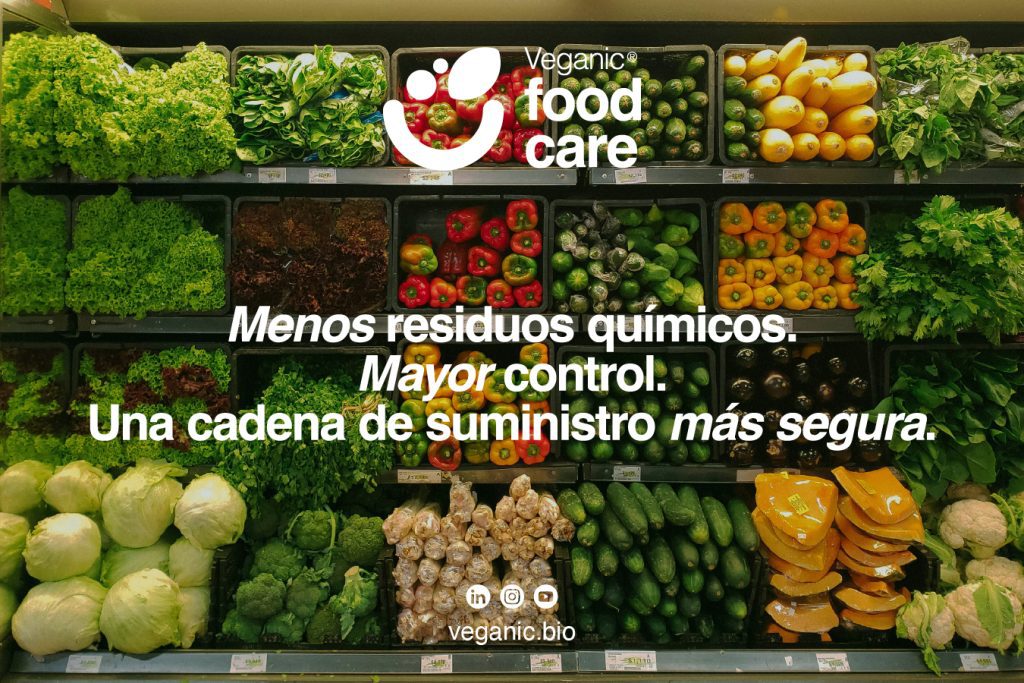
The future of food begins in the field
Veganic Food Care is not just a project. It is a concrete way to move toward a more transparent, fair, and healthier food system.
Our fundamental pillar is sustainability, and our purpose is clear:
To leave a better world for future generations.
With Veganic Food Care we take another step forward so that producers, supermarkets, and consumers move together toward an agriculture that protects the soil, health, and the future.