

Interest in botanical insecticides has grown for reasons that have little to do with fashion. The number of authorised conventional active substances in the European Union has fallen substantially over the last two decades, resistance has developed in most economically important pests, maximum residue limits demanded by retailers are increasingly stricter than those set by regulation, and the area under organic production continues to expand. Plant extracts sit at the intersection of all four pressures.
They are not, however, a straightforward substitute. A botanical insecticide behaves differently from a synthetic one, and expecting the same kind of result is the most common cause of disappointment. Understanding what these substances actually do — and what they do not do — is what makes them useful.
What Botanical Insecticides Are
Botanical insecticides are products whose active substances are compounds produced by plants, generally obtained by extraction from leaves, seeds, roots or bark. They are not a novelty: pyrethrins from Chrysanthemum cinerariaefolium and rotenone from Derris species were in agricultural use long before synthetic chemistry became dominant.
Two characteristics define them technically:
Chemical complexity. A synthetic insecticide is usually a single molecule with a single defined mode of action. A plant extract is a mixture of dozens of compounds — flavonoids, tannins, terpenes, alkaloids, phenolic acids, fatty acids — acting in combination. That complexity has an advantage worth noting: multiple simultaneous mechanisms make the selection of resistant populations slower, because a pest cannot circumvent several pathways with a single mutation.
Rapid degradation. Most botanical compounds break down quickly under ultraviolet light, oxidation and microbial activity. This is the basis of their favourable residue profile and short pre-harvest intervals, and it is simultaneously their main agronomic limitation: little persistence, so timing and repetition matter more than with conventional products.
From a regulatory standpoint, the European framework provides two relevant routes: the basic substance status of Article 23 of Regulation (EC) No. 1107/2009, for substances that are not predominantly used as plant protection products and present no immediate concern, and the low-risk active substance category. In the United States, several plant-derived substances are covered by the exemptions of FIFRA Section 25(b). Knowing which route a product follows determines what can legally be claimed about it.
The Link with Plant Defence Mechanisms
Plants cannot escape an attack, so they have evolved chemical defences instead. Much of what a botanical insecticide does is borrowed directly from that arsenal.
Plant secondary metabolites — compounds not involved in primary growth and reproduction — serve largely defensive purposes: deterring feeding, interfering with digestion, disrupting hormonal regulation in insects, or signalling to natural enemies of the herbivore. Some are produced constitutively, others are induced after damage, and their production often intensifies under stress.
This matters for two reasons. First, it explains the diversity of effects seen with plant extracts: they were never designed as neurotoxins, so their activity tends to be spread across feeding behaviour, development and reproduction rather than concentrated in rapid mortality. Second, it means that some extracts act as much on the plant as on the pest, stimulating its own defensive responses — a mechanism that blurs the boundary between insecticide and elicitor and that is central to current research.
Why Nettle and Chia Are of Interest
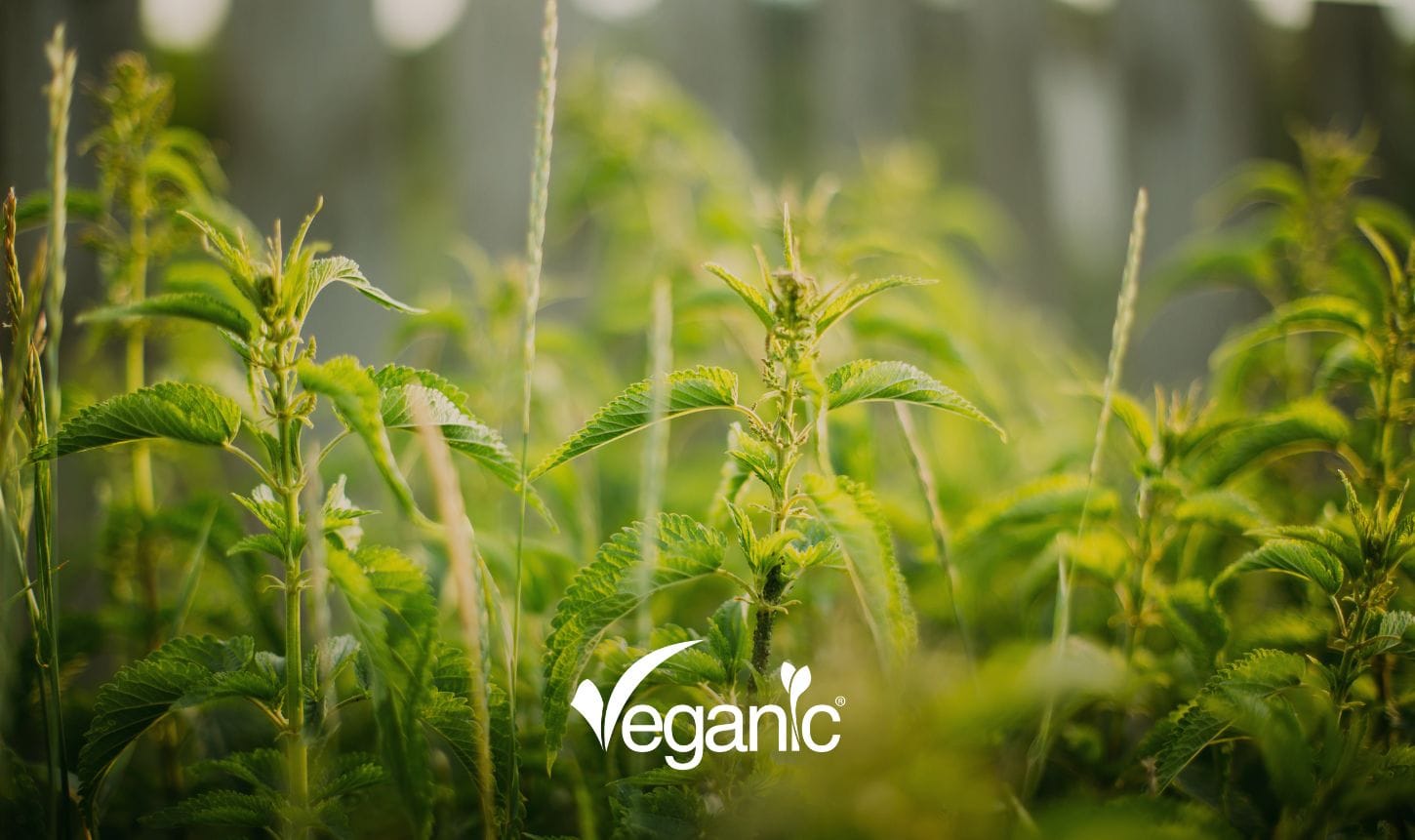
Nettle (Urtica dioica) is the best documented of the two in an agricultural context. Its aerial parts are rich in bioflavonoids, tannins, phenolic acids, sterols and organic acids. Traditional European agriculture used nettle preparations against aphids and mites long before there was any analytical explanation for their effect, and that historical use is precisely what supported its assessment as a basic substance in the European Union.
Its reported activity concentrates on soft-bodied pests in early stages — aphids, mites, young nymphs — and it is progressive rather than immediate. There is no knockdown effect: populations decline over days, and efficacy depends closely on coverage and on repetition, because there is no persistence between applications and no vapour action.
Chia (Salvia hispanica) is a more recent line of enquiry. Its seeds are known for their content of omega-3 fatty acids, mucilage and phenolic compounds, and it is that fatty acid and mucilage fraction that has drawn attention: certain fatty acids and their derivatives interact with insect cuticles and with membrane integrity, while mucilaginous fractions modify the physical properties of a spray solution — adhesion, spreading, contact time on the leaf surface.
It is important to be precise here. Research on chia derivatives in crop protection is at an exploratory stage, and results are not directly comparable with the documented use of nettle. Presenting it otherwise would misrepresent the state of the evidence.
How Plant Extracts Can Act on Pests
The activity of botanical substances is generally distributed across several mechanisms, none of which produces the immediate mortality associated with conventional insecticides:
Antifeedant effect. Compounds such as tannins and certain terpenes make treated tissue unpalatable. The insect reduces or stops feeding, which limits damage and weakens the population, though the individuals may remain visible on the plant for some time — a point worth explaining when assessing efficacy in the field.
Repellency. Volatile compounds interfere with host location, reducing colonisation. This effect is preventive by nature and does not resolve an established infestation.
Interference with development. Some substances disturb moulting and metamorphosis, causing mortality at stage transitions or producing malformed adults.
Effects on reproduction. Reduced fecundity and oviposition on treated surfaces slow population growth between generations, which is often more relevant to the season’s outcome than immediate mortality.
Physical action. Fatty acids, oils and other lipophilic fractions damage the cuticle or block the respiratory system, a purely mechanical mode of action with no known resistance mechanism against it.
Two practical consequences follow. Efficacy must be evaluated several days after application, not the following morning; and these products belong in a preventive or early-intervention position in the programme, not as a rescue treatment on a fully established outbreak.
Formulation and Field Validation
An extract with proven activity in the laboratory is not yet a usable product, and this is where most botanical projects fail.
Standardisation. The composition of a plant extract varies with the variety, growing region, harvest date, plant part used and extraction method. Without a standardised production process and analytical control of marker compounds, efficacy varies from batch to batch — historically the main reason for the poor reputation of some botanical products.
Stabilisation. Active compounds must survive storage and, once applied, resist ultraviolet degradation for long enough to act. Antioxidants, encapsulation, micelle-forming systems and adjuvants that improve UV protection are decisive in converting laboratory activity into field performance.
Application properties. Wetting, spreading and adhesion determine whether the substance reaches the pest at all — particularly on hairy or waxy leaf surfaces, and on pests that sit on the underside of leaves. Spray solution pH also affects the stability of many plant compounds.
Field validation. Efficacy trials under real conditions, across seasons, crops and pest pressures, are what separate a promising extract from a reliable tool. They also define the practical envelope: which pest stages respond, at what interval applications must be repeated, and how the product behaves in mixtures and alongside biological control agents.
From Knowledge to Field Application: Veganic’s Work with Plant-Based Technologies
Veganic’s research and development work sits precisely at that translation point — from a plant compound with documented activity to a formulation that performs consistently in the field.
That work starts where most of the difficulty lies. Selecting a promising extract is comparatively straightforward; what takes time is standardising the raw material so that every batch delivers the same concentration of marker compounds, stabilising the active fraction against ultraviolet degradation, and adjusting the formulation so that the substance genuinely reaches the pest — including on waxy leaf surfaces and on the underside of the canopy, where most soft-bodied pests are found. Only then does field validation across crops, seasons and pest pressures establish the practical envelope of a product: which stages respond, at what interval it must be repeated, and how it behaves alongside biological control agents.
It also requires being clear about what belongs where. Nettle has a documented history of agricultural use and a defined regulatory route in Europe; work on other plant matrices — including fatty acid and mucilage fractions such as those found in chia — belongs to the research pipeline rather than to the product range, and Veganic reports it as such. The distinction matters: an extract under investigation and a registered product with authorised uses are different things, and treating them as equivalent damages the credibility of botanical crop protection as a whole.
That is the position from which Veganic works with plant-based technologies: taking mechanisms that plants have already developed, standardising and stabilising them into formulations that behave predictably, and validating in the field what the laboratory suggests. If you are considering how botanical substances could fit into your own pest management programme, our technical team will be glad to discuss it with you.